The two of us are often in a rush or running late, and this day is no exception. We have booked a whale safari with Whale2Sea in Andenes for the morning, so it means packing early, tidying up and checking out. Of course we still leave a quarter of an hour later than planned.
We don’t get far. After about three kilometres a car stands across the road, because it is closed for roadworks. There is no way through. So we drive all the way around Andøya, a detour of about an hour. Nobody answers the phone at Whale2Sea this early, and our email gets no reply. Nicolas makes up some time on the way, and we arrive in Andenes at 9.30 instead of 9.15. Not bad at all, really. Only everyone else is already waiting, and we are by far the last.
By RIB boat to the sperm whales
After a short briefing everyone gets a special neon yellow, waterproof thermal suit, because it gets cold out on the water. Then we set off in two small RIB boats with hydraulic seats, each with a captain and a guide on board. The half hour ride out is an experience in itself. With waves two to four metres high it feels like a day at Europa-Park, and at times like galloping across the sea. In any case we have a huge amount of fun.
We always spot the whales first by their blow. When they breathe out, they puff the water into the air as a cloud. Annina sees the first one from far away, and soon after a fin as well. Because this whale is still quite far off, the guides locate more animals with their hydrophone. The waters off Andenes are home to male sperm whales. Our guide is doing his PhD on sperm whales and knows a great deal about them. A little fun fact from him: Sperm whales make sounds of up to 220 decibels, as loud as a jet engine. With these clicks they locate their prey in the pitch dark depths, mostly squid, much like bats with their echo. They usually hunt 400 to 1,200 metres down. Once a whale has finished hunting and rises again, it falls silent. The ascent usually takes six to eleven minutes and is silent, and at the surface it doesn’t need the clicks, it just catches its breath there. That is handy for the guides: When the clicks in the hydrophone stop, the whale will surface soon. Through the hydrophone the guides know exactly how deep a whale is and how far it is from the boat. This lets us really follow individual animals, always at a good distance. The wellbeing of the whales comes first here.
The guide tells us that the sea beneath us is about 600 to 800 metres deep here. Off Andøya the edge of the continental shelf lies closer to the coast than almost anywhere else in Norway. Beyond it the seabed drops steeply, and in the underwater canyon of Bleiksdjupet it goes down more than 1,000 metres. Nutrient rich water rises from the depths, and fish, seabirds and the sperm whales, which dive for squid here, all live off it. On the seabed there are cold water coral reefs, coral forests and sponge forests that usually only occur much deeper. Only on 18 September 2026, not quite two weeks ago, did Norway protect the area as the Andfjorden marine protected area. At 1,848 square kilometres it is the country’s largest marine protected area so far.
He also tells us that one of the sperm whales they fitted with a transmitter here swam all the way to Brazil to mate with a female there. There is a study on this, published in 2025. Between 2020 and 2023, researchers from the Norwegian Polar Institute and the University of Tromsø, together with Whale2Sea fitted 29 male sperm whales off northern Norway and Svalbard with satellite tags. Twelve of them headed south and spread out across the Atlantic, from the seas off the Canary Islands and Cape Verde to waters close to the Caribbean and Brazil. The one that went furthest was a bull tagged off Andenes in March 2023. At his furthest point he was almost 8,000 kilometres from here in a straight line, and he returned north after a journey of 175 days and almost 17,700 kilometres. Only the adult males come this far north, to feed. The females stay with the young in groups in warmer waters, and that is also where sperm whales mate.
How a sperm whale finds its way over such a distance without GPS is not really known. One widely held idea is a magnetic sense. In a pool, bottlenose dolphins swim towards a container holding a strong magnet much faster than towards an otherwise identical one without. On the east coast of the USA, whales and dolphins strand noticeably often where the magnetic field is weaker than in the surrounding area, and grey whales strand more than four times as often during a strong solar storm. On their migrations, however, humpback whales often hold a course to within one degree for more than 200 kilometres, despite changing currents. Because the Earth’s magnetic field varies, the researchers think a magnetic sense alone can hardly explain that. Whales may combine several cues, such as the magnetic field and the position of the sun.
After the first one we see three more whales. Each one announces itself with its blow, stays at the surface for a few minutes and then dives again, every time showing its tail fluke beautifully. Of course we try to take photos, and a few of them turn out. The whales are rather far away, but that is perfectly fine. They shouldn’t be scared, after all.
We head back towards land at a good pace. By now we are quite cold, and after all the shaking we are glad to have solid ground under our feet again and to get somewhere warm. So we go straight to a café. There is a cinnamon bun for Nicolas, and an egg sandwich and a cappuccino for Annina.
Måtind in the evening light
Because the weather finally plays along properly, we add a hike up Måtind in the afternoon, one of the best known hikes up here on Andøya. After about 450 metres of ascent and roughly an hour and a half we stand on the summit. The climb is a typical Norwegian trail. In places we have to scramble and find the way ourselves, but by now we have got the hang of it.
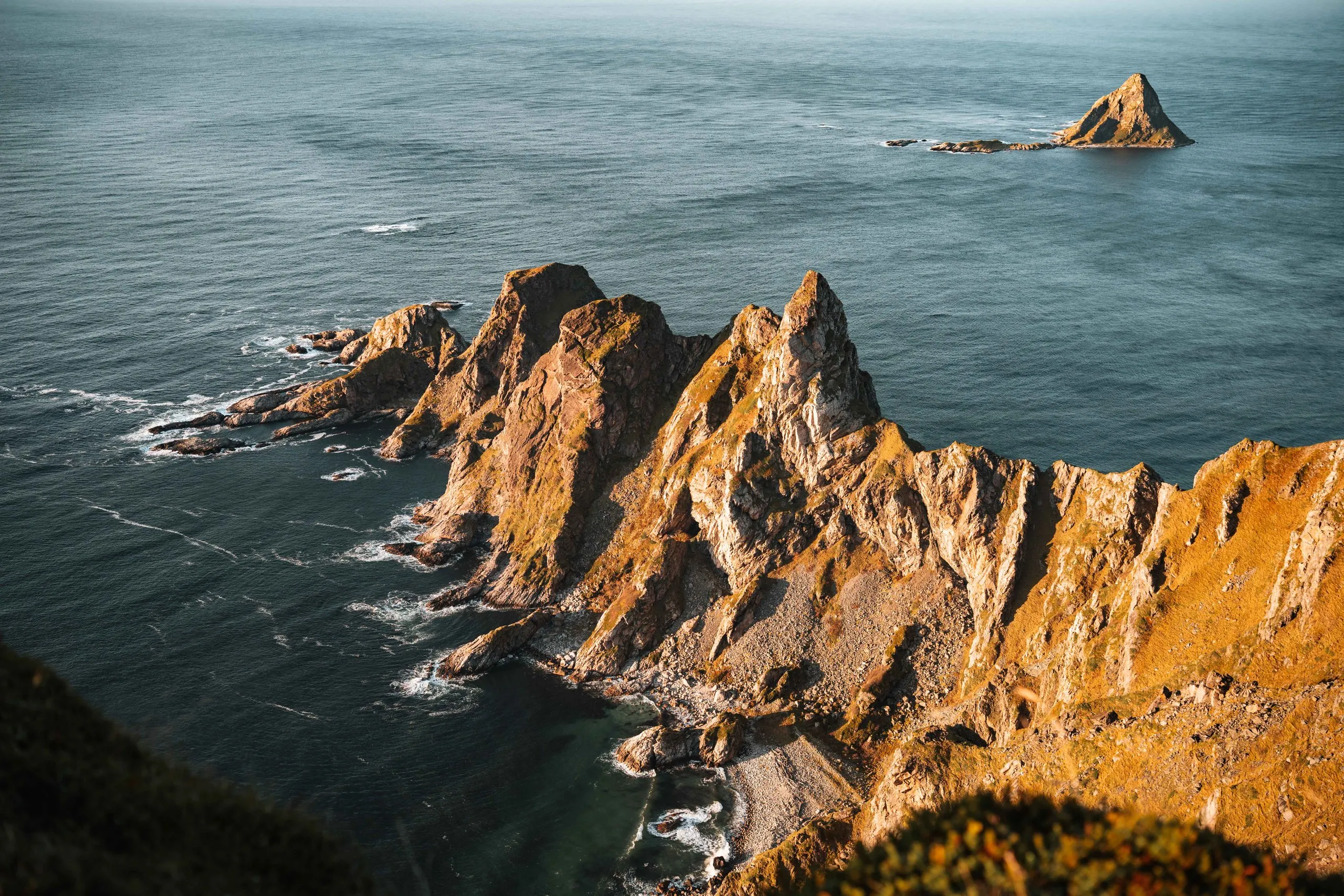
We are lucky and reach the top just as the sunset light begins. The view is even better than we had hoped. On the left lies the beach of Bleik, on the right an impressive rock formation and behind it the triangular bird island of Bleiksøya.
As a highlight we then spot ptarmigan, which we can photograph against the mountain backdrop. Otherwise we are almost alone with nature, with only the odd person passing by now and then.
The descent is a little trickier, but very beautiful in the moonlit mood around us. Nicolas has only packed his sunglasses, which are not much help as the sun goes down, and towards the end it gets quite dark. After a short scramble over loose stones we make it down well and arrive at the bottom safely.
On the drive below we see another incredible sunset, looking out at the triangular bird island of Bleiksøya.
Now we are sitting in the car with about three hours of driving to Bø ahead of us, where our next Airbnb is waiting. It is supposed to be overcast, so we don’t really expect northern lights tonight. But who knows what this day still has in store.
Comments
Questions, tips or just a hello: We are happy about every message.